
Updated: May 2026
——- Twinkle, Twinkle Little Star. How can we Keep Our Kennisis Night Skies Dark? ——
Dark Skies Full of Stars
During a moonless night, you should be able to see 2,500 to 3,500 stars and the Milky Way. Star gazing can be an amazing family activity that invokes scientific curiosity, imagination, and discussions of our past, culture, and future. It’s estimated that today, only one in ten children will see a sky full of stars. Because of light pollution, people in cities generally see less than 100 stars on a ‘good’ night. Even in cottage country, away from city lights, light pollution on our lakes can mean we see only a fraction of the thousands of stars that should be visible to us.
Light pollution is created by artificial light at night and includes the light from lake facing night lighting, glare from interior lighting, wandering light (or light trespass), excess lighting, and lighting that affects wildlife.
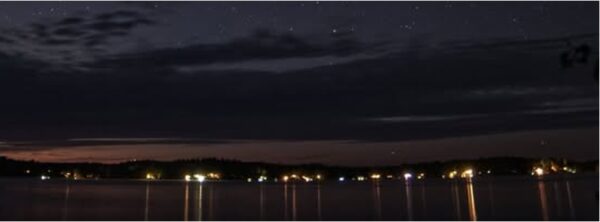
Light pollution can be easily reduced with some simple solutions:
- Shield your light fixtures so light shines where you need it, not toward the lakes or over your neighbour’s property. Everyone will see better without the glare.
- Strings of lights have become popular along staircase railings, decks and at the shoreline, but these lights are unshielded so light shines up and out instead of down, and glare is reflected and magnified across the water.
- Use amber “bug lights” – not white light. Amber will reduce the impact of glare and will also attract fewer mosquitoes.
- Use lower wattage lamps. To judge how much light you need, go for a walk at night and approach your lights after becoming dark-adapted. Or paddle straight out from your dock at night and look at what you see at your own property. This will be what the animals see. If your lights are bright, dim them down or use a lower wattage bulb.
- When not outside, keep lights off when possible. Motion sensors can ensure that lights don’t come on or stay on when they are not needed.
- Turn off your outdoor lights when you don’t want to have visitors, when you go to bed, and certainly when you are away. We’ve been told to use light to make our homes safer, but without an active security system, outdoor lighting won’t protect your property, it just puts it on display for thieves and vandals.
KLCOA – Dark Skies Resource Sheet (Updated 01SEP2025)
For more information on Dark Skies at our Lakes check these links:
Outdoor Lighting – From the Land Between
Why Dark Skies? – From the International Dark Sky Association
Love Your Lake – Shoreline Lighting…How important is it? – From Watersheds Canada
How Light Pollution Steals our Night – From Environment Haliburton
Dark Sky Brochure – Trent Lakes – From Municipality of Trent Lakes
FOCA Night Skies Fact Sheet – From Federation of Ontario Cottagers’ Association
Current Year Event Details
Dark Skies Night – August 15, 2026
Let the Stars Shine — Dim the Lights starting at 10:00 PM
What does “Dim the Lights” mean?
We’re asking everyone around the lake to reduce unnecessary outdoor lighting so we can enjoy a darker, more star-filled sky together.
- Turn off decorative and excess outdoor lighting
- Dim or switch off dock, shoreline, and landscape lights
- Only keep lights on where needed for safety
- Reduce indoor light spill by turning off unnecessary lights
This is about reducing light pollution, not turning everything off completely.
Why it matters
- See more stars and the Milky Way
- Enjoy a more peaceful, natural nighttime environment
- Help protect local wildlife that depend on darkness
Join your neighbours
Just a small change—starting at 9 PM on August 15, 2026—can make a big difference.
Together, let’s give the night sky a chance to shine.